

 English / engels
  Dutch / nederlands
[All pictures of garden wildlife on this page are thumbnails. Click on any thumbnail for a large format to be displayed.]
Bugs, Cicadas and Aphids (Hemiptera)
All Hemiptera have needle shaped jaws. This needle is used to stick into animals or plants and to suck up the juices. There are three groups: the real bugs, the cicadas and the plant lice, also called green flies. The larvae resemble the adults very much with one exception: the wings. Hemiptera do not start their life looking like a caterpillar or maggot but just like with dragon flies, the young form is called nymph. This also implies that there is no pupal stage for these animals.
Scientifically the Hemiptera consists of two different groups: the true bugs (or Heteroptera) and the cicadas and green flies (Homoptera). The true bugs have two pairs of wings. The upper wing is quite remarkable as it is made of two parts: a firm part first and a much softer membranous second half. The lower wing is membranous entirely and looks like the wings of all insects. The Homoptera have four wings as well. The upperwing in cicadas is either membranous or looks like the beetle's shields. The second pair is entirely membranous. Green flies have two pairs of membranous wings, resembling the wings of flies or wasps. However many are wingless as well. Because of the huge difference between true bugs and green flies some people believe these actually belong to two separate orders.
Scientifically the Hemiptera consists of two different groups: the true bugs (or Heteroptera) and the cicadas and green flies (Homoptera). The true bugs have two pairs of wings. The upper wing is quite remarkable as it is made of two parts: a firm part first and a much softer membranous second half. The lower wing is membranous entirely and looks like the wings of all insects. The Homoptera have four wings as well. The upperwing in cicadas is either membranous or looks like the beetle's shields. The second pair is entirely membranous. Green flies have two pairs of membranous wings, resembling the wings of flies or wasps. However many are wingless as well. Because of the huge difference between true bugs and green flies some people believe these actually belong to two separate orders.

Shieldbugs (various families)
Shieldbugs are among the best known bugs. They are rather shaped like a medieval shield, hence the name. Various families are considered to be part of this group. Best known species is the Green Stinkbug, common in nearly every garden in Britain. Some species, especially when the adults overwinter, change their colour just before overwintering. Some bugs like the Common Green Capsid are harmful insects, while other, such as Arma custos are very useful because they are enemies of the weevils.
Click here to select a species.
Shieldbugs are among the best known bugs. They are rather shaped like a medieval shield, hence the name. Various families are considered to be part of this group. Best known species is the Green Stinkbug, common in nearly every garden in Britain. Some species, especially when the adults overwinter, change their colour just before overwintering. Some bugs like the Common Green Capsid are harmful insects, while other, such as Arma custos are very useful because they are enemies of the weevils.
Click here to select a species.
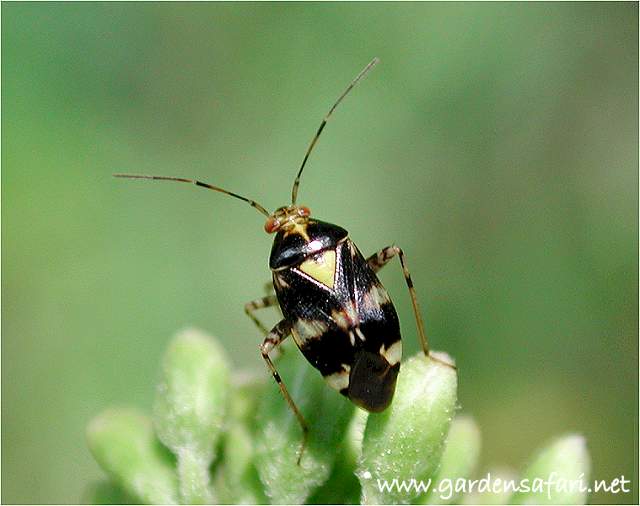
Plantbugs (Miridae)
Measuring some 3 to rarely 10 mm Plantbugs are much smaller than Shieldbugs. They are shaped differently as well, for many are more or less egg-shaped. Nearly all of them are strict vegetarians. Their common characteristic is the lack of ocelli. Ocelli are very small, dot shaped, primitive eyes. Most bugs have two ocelli, sometimes even four, but Plant Bugs have none.
Click here to select a species.
Measuring some 3 to rarely 10 mm Plantbugs are much smaller than Shieldbugs. They are shaped differently as well, for many are more or less egg-shaped. Nearly all of them are strict vegetarians. Their common characteristic is the lack of ocelli. Ocelli are very small, dot shaped, primitive eyes. Most bugs have two ocelli, sometimes even four, but Plant Bugs have none.
Click here to select a species.
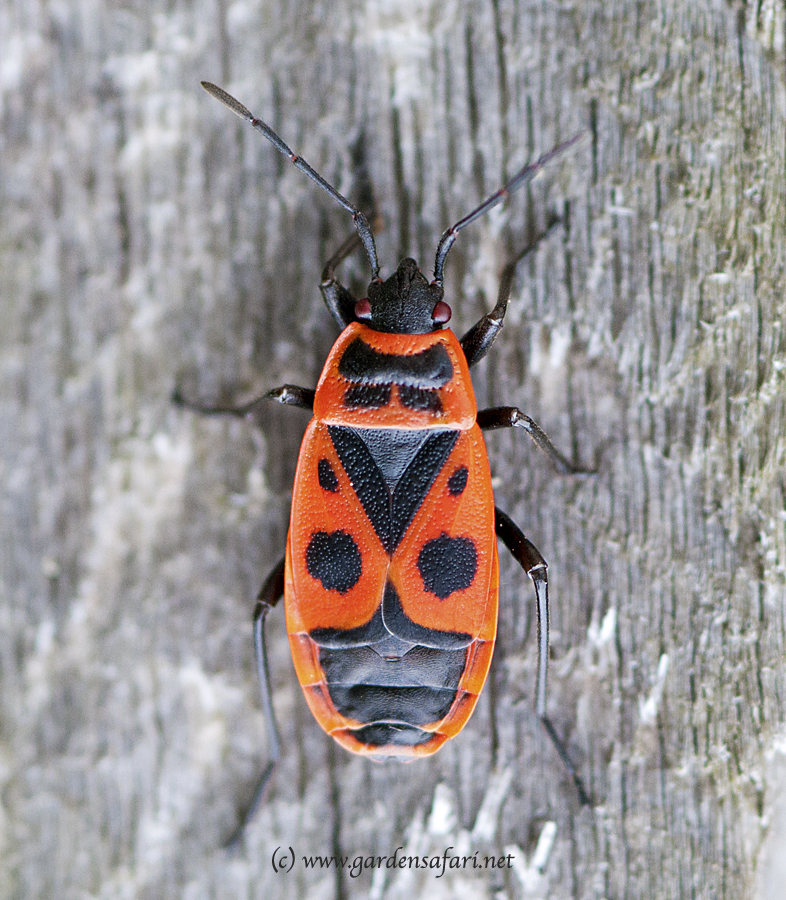
Other real bugs (various families)
Here are bugs that have not been mentioned on the previous pages. They actually have little in common with Plantbugs and Shieldbugs. Most of them belong to smaller families, or they simply look different. Here you will find the Fire Bug, the Water Strider and the Ant Damsel Bug, etc.
Click here to select a species.
Here are bugs that have not been mentioned on the previous pages. They actually have little in common with Plantbugs and Shieldbugs. Most of them belong to smaller families, or they simply look different. Here you will find the Fire Bug, the Water Strider and the Ant Damsel Bug, etc.
Click here to select a species.
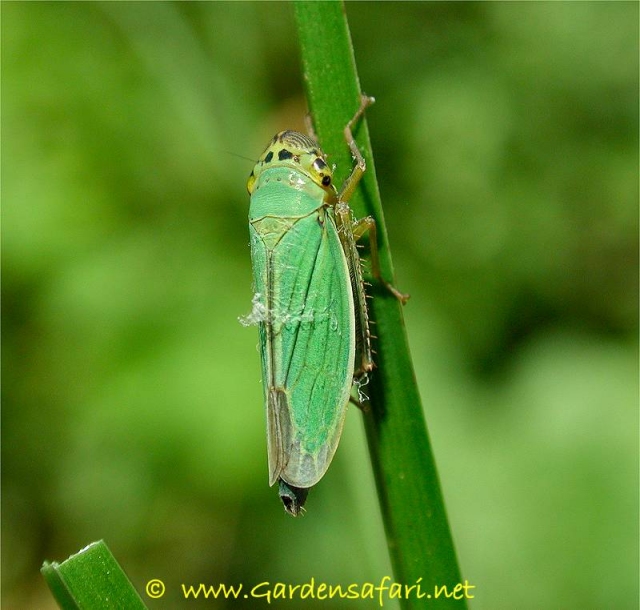
Cicadas (Auchenorrhyncha)
Cicadas are best known by those travelling to the Mediterranean. Cicadas are the (usually) brown animals making a constant noise day and night. In the tropics there are meny more species, some very big, colourful and oddly shaped. In Britain most species are small and quite silent. Cicadas put their wings together in a kind of semi upright position. Cicadas are capable flyers and jumpers. The famous spittle bugs are cicadas as well.
Click here to select a species.
Cicadas are best known by those travelling to the Mediterranean. Cicadas are the (usually) brown animals making a constant noise day and night. In the tropics there are meny more species, some very big, colourful and oddly shaped. In Britain most species are small and quite silent. Cicadas put their wings together in a kind of semi upright position. Cicadas are capable flyers and jumpers. The famous spittle bugs are cicadas as well.
Click here to select a species.

Aphids (Sternorrhyncha)
Aphids are small, vulnerable insects, usually found sucking on plants, sometimes in great numbers. Many species have complicated life cycles, including the production of winged and wingless generations and sexual and parthenogenetic reproduction. Not only the common aphids belong to this group, but the Wooly Plant Lice and the Scale Insects are also part of this complicated group. Species are extremely difficult to identify. Knowing the host plant however often helps enormously.
Click here to select a species.
Aphids are small, vulnerable insects, usually found sucking on plants, sometimes in great numbers. Many species have complicated life cycles, including the production of winged and wingless generations and sexual and parthenogenetic reproduction. Not only the common aphids belong to this group, but the Wooly Plant Lice and the Scale Insects are also part of this complicated group. Species are extremely difficult to identify. Knowing the host plant however often helps enormously.
Click here to select a species.
Thanks to Dr. Wolfgang Rabitsch, Keith Edkins, Wim Bloemberg, J. Baugnee, Gaby & Jos (Koninklijke Antwerpse Vereniging voor Entomologie), Berend Aukema and Gerrit Tyberghein for their help identifying various species.


© Copyright 1998-2024 gardensafari.net (Hania Berdys)