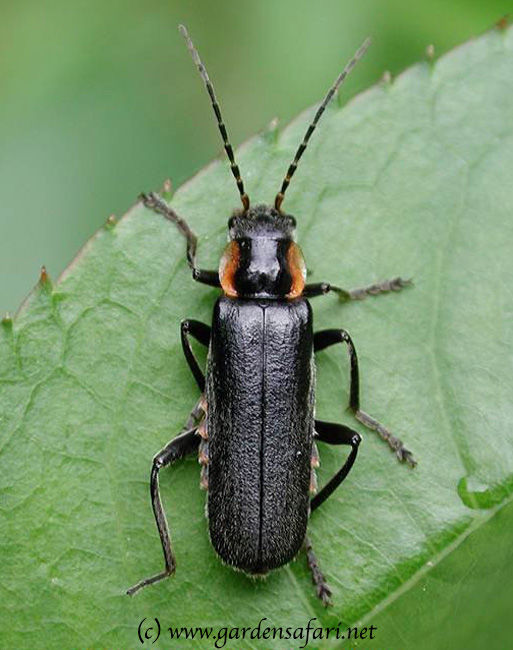
Soft-winged Beetles
Soldier Beetles are also called Soft-winged beetles, because of the softness of their shields. That is why we have put them together with another family of rather soft-winged beetles: the often magnificent Soft-winged Flower Beetles. However the two families are not really closely related.
Contents: 1 Soldier Beetles, 2 Soft-winged Flower Beetles.
![]()
1 Soldier Beetles (Cantharidae)
When you look at them vertically you can see that the soldier beetles are called that way because they really do remind one of old fashioned soldier uniforms. There are over 50 species in the Low Countries. Many species are very similar and therefore difficult to tell apart. Often you can find them sunbasking on flowers. The adults eat other insects. In some casese they hunt for prey, but most eat animals that are already dead. The larvae hunt for snails, slugs and worms on the ground, even though there are some vegetarians among them. The most common of all soldier beetles probably is the Hogweed Bonking Beetle below. In summer they often appear in great numbers, basking in sunshine or copulating on flowers, especially umbellifer. As the flowers of many umbellifers are whitish the beetles are very striking. Due to their reddish colours birds will leave them alone. Reaching some 7 to 10 mm in length it is a typical representative of its family. As the species also loves verges and banks it may be considered to be a real opportunist, explaining its abundancy all over Europe and the British Isles. It is an excellent species to predict a thunderstorm, for when all the animals are retreating to the backside of leaves a thunderstorm will be advancing. Do not hurry though: they take shelter many hours before the thunderstorm arrives! You can tell them apart from most family members by looking at the colouring: the entire head ans neck shields are red, the shields are dark red, except for the ends where they get darker and the legs are red, except for the feet.
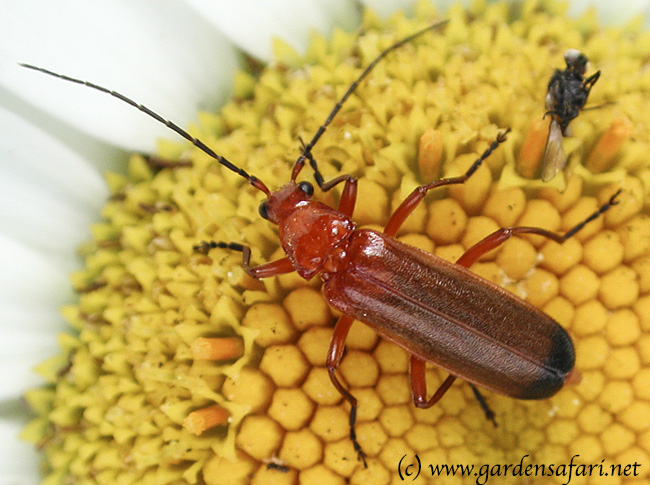
The Hogweed Bonking Beetle (Rhagonycha fulva) is often seen in copula on plants and flowers.
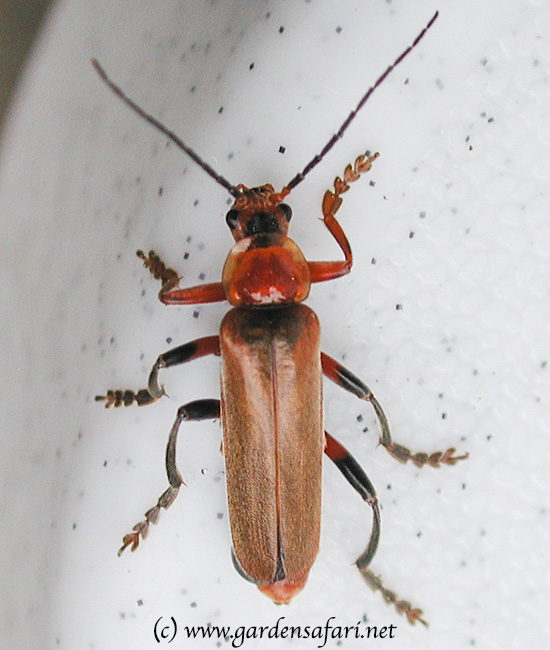
Below one of the more difficult species, for it appears in two variations. Most seen is a light reddish yellow appearance. But quite often the dark reddish brown variation keeps popping up. In German the common name of this animal is well choosen: the "variable soft-wing". The dark form looks like many other soft-wings, especially the Hogweed Bonking Beetle above. Yet the differences are not that difficult to see. C. livida has a black forhead, the legs change from red to black and while the Hogweed Bonking Beetle has the last part of the shields darkened, those of C. livida are darker on the front. This is a common species, and sometimes even abundant species in many parts of Britain and a very common to abundant species on the continent.
This is the very common Cantharis livida in its dark variation.
Below another red species. It often looks like the red form of Cantharis livida a lot and sometimes one needs to examine the genitals to tell both species apart. But usually Cantharis rufa is the smallest of the two, the shields do not begin in a dark colour and the black spot on the neck shield is either absent or much smaller than Cantharis livida's. This is a wide spread species found all over Europe, including all of the British Isles and Ireland, Siberia and parts of Northern Asia, everywhere even beyond the Arctic Circle.
The identification of this species, Cantharis rufa, may be troublesome at times.
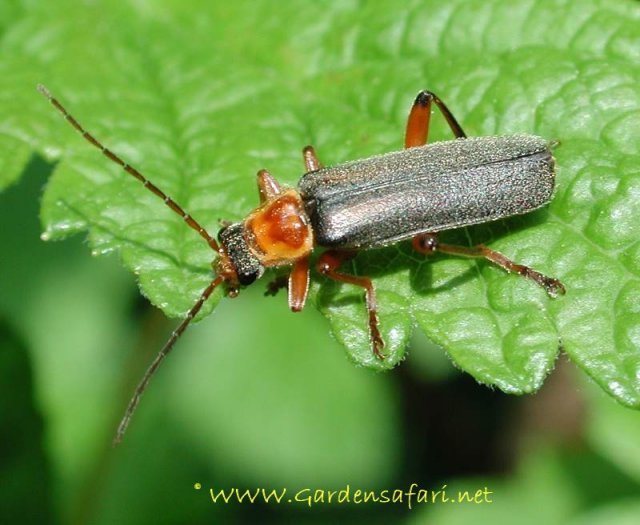
Many species in this family are blackish. These blackish species are often referred to as Sailor Beetles. So the species below is one of those. It is a little bigger than the Hogwood Bonking Beetle, measuring some 10 to 14 mm. It is a common species in Europe, but never as abundant as the two previous species, as it is usually found in flowery meadows and fringes of woodlands. Look for the following characteristics: the face is red, the head is black, the neck shield is red with no black markings, the shields are black and the legs are black, except for the first part.
One of the so-called Sailor Beetles: Cantharis pellucida.
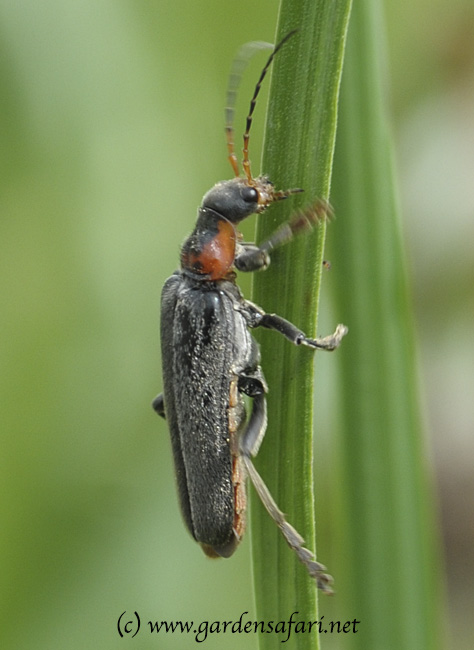
Another typical Sailor Beetle is the species below. In order to identify it pay attention to the fact that it is all black, except for the edges of the neck shield which are red. The larvae live in oak mainly, but are often found in orchards as well. They may be harmful to the trees, when there are a lot them. But not only do they eat fresh leaves, they hunt for aphids and other small insects as well. Once adult they measure some 9 to 13 mm. in length. The adults have the same diet as the larvae have. It is a common species all over Europe, including Scotland.
This black soldier beetle is called Cantharis obscura.
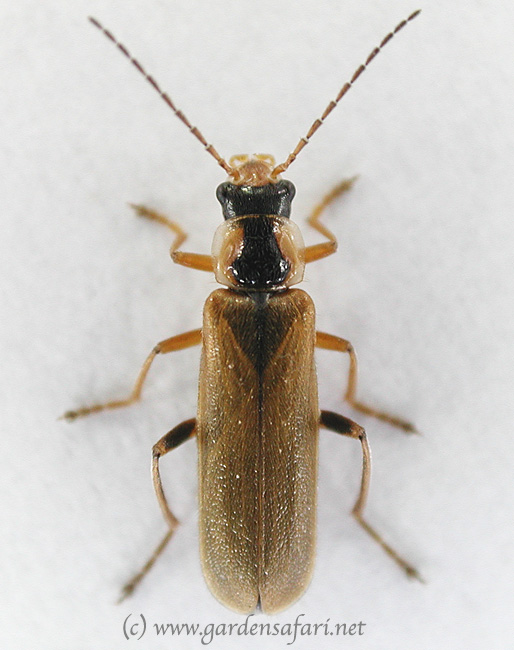
Yet another appeared in our garden. It appeared right after winter and it is therefor fair te assume it hibernated as an adult. Because of the hibernation the colours may be non typical. According to Boris Büche we are talking about Rhagonycha testacea. Reaching a length of some 9 to 12 mm, this too is a typical representattive of its family. It is common all over Europe, including all of the British Isles and is found in parts of the USA as well.
Another Rhagonycha in our garden: Rhagonycha testacea, another species without common English name.
1.5 Soft-winged Flower Beetles (Malachiidae)
Below a very beautiful beetle. It is one of the Malachids, of which some 16 species can be found in Britain. Each species has its own combination of metallic colours, usually green and red or blue and red. Malachids have soft wings as well and their shape reminds one of the soldier beetles as well. But usually their shields are quite short, leaving the rear end of the actually body exposed. The species below is called Red-tipped Flower Beetle for obvious reasons and it is a frequently seen species in many gardens. It hunts for other small insects, but eats pollen as well. The species can be seen from early spring till late autumn, although it is abundant in June and July only. It used to live in wildflower fields and meadows, but later invaded parks and gardens as well. It shows little variation in length: some 6 mm. The larvae are hunters. They are found in cow dung and moulded wood.
The Red-tipped Flower Beetle (Malachius bipustulatus) can be found on flowers, hunting for other insects.
All pictures © Hans Arentsen (info@gardensafari.net) and © Hania Arentsen (photog@gardensafari.net).
Also visit Hania's Photographer's Pages, including pictures from Holland, Germany, China, the USA and Malaysia.
This page has last been modified on Saturday, January 20, 2007.
© www.gardensafari.net (Hania Berdys).